





The secret to transformer reliability lies in the often-overlooked component: the bobbin.
When designing transformers for demanding applications, professionals face a constant challenge: how to ensure reliability under high temperature conditions? The transformer bobbin, while seemingly simple, plays a critical role in determining overall performance and longevity.
Selecting the appropriate bobbin isn't just about dimensions-it's about understanding material characteristics, thermal properties, and manufacturing considerations that directly impact your transformer's functionality in real-world conditions.

Understanding Transformer Bobbin Materials: Beyond Basic Plastics
Transformer bobbins come in different materials, each with distinct properties suited for specific environments. The choice between thermosetting and thermoplastic materials often represents the fundamental decision point in high-temperature applications.
Thermosetting materials like Bakelite (PM) offer exceptional high-temperature resistance, maintaining stability at temperatures up to 150°C and even withstanding short-term exposure to temperatures as high as 370°C. This material demonstrates minimal deformation under thermal stress, making it ideal for applications where temperature fluctuations are significant. However, its relative fragility requires careful handling during manufacturing processes.
Thermoplastic materials include several options with varying characteristics:
Nylon (NYLON) provides good ductility and resistance to breakage, though it has a lower temperature resistance (115°C) and tends to absorb moisture, requiring pre-use baking at 80°C to ensure stability.
PET materials offer higher temperature resistance (170°C) and greater hardness, making them suitable for winding pipes.
PBT materials are somewhat softer and have lower temperature tolerance (160°C), but still find use in specific applications.
The Critical Role of Bobbin Geometry: Horizontal vs. Vertical Designs
Bobbin orientation-whether horizontal or vertical-significantly impacts transformer performance and manufacturing processes. Horizontal bobbin transformers often provide advantages in winding processes, particularly for automated production lines. These designs typically allow for easier winding and can accommodate different winding techniques that affect the transformer's electrical characteristics.
The choice between horizontal and vertical designs affects multiple aspects:
Winding efficiency and automation compatibility
Heat dissipation characteristics
Space utilization within electronic assemblies
Manufacturing yield and production costs
Engineers using design tools like PI Expert sometimes encounter limitations when trying to switch between vertical and horizontal bobbin configurations, particularly with less common core types. This underscores the importance of selecting the appropriate bobbin early in the design process.
Advanced Winding Techniques for High-Frequency Applications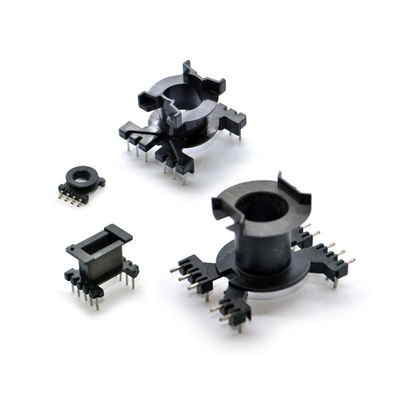
High-frequency transformer bobbins require specialized winding techniques to maintain performance and reliability. Proper winding methodology affects everything from capacitance characteristics to thermal management.
For vertical bobbins, technicians typically apply different winding principles based on wire thickness:
Thick wires (0.8φ above) require approximately 1 wrap
Medium wires (0.2-0.8φ) need about 1.5 wraps
Very fine wires (under 0.2φ) may require 2-3 wraps
The fundamental principle for vertical bobbins involves winding as close to the bottom as possible without exceeding the convex point. This approach ensures optimal mechanical stability and electrical performance.
Overcoming Common Bobbin Challenges: Breakage Prevention and Quality Assurance
Bobbin breakage represents a significant concern in transformer manufacturing, particularly with certain materials. Preventing this issue requires understanding both material properties and processing techniques.
Thermoplastic materials offer different recycling capabilities-approximately 20% for the first recycling, 15% for the second, and about 7% for the third round. This recyclability factor becomes increasingly important in environmentally conscious manufacturing environments.
Quality assurance measures for bobbins include:
Pre-baking moisture-sensitive materials like Nylon
Implementing proper soldering techniques to prevent bobbin damage
Maintaining clean manufacturing environments to prevent contamination
Conducting regular dimensional checks to ensure consistency
Certification Considerations: IEC and UL Standards
Compliance with international standards such as IEC and UL requirements isn't just about market access-it's about ensuring safety and reliability in critical applications. These certifications verify that transformer bobbins meet specific safety, performance, and durability requirements.
When selecting bobbins for certified applications, consider:
Material flammability ratings and tracking resistance
Thermal endurance under continuous operational stress
Dielectric strength and insulation properties
Long-term aging characteristics and performance degradation profiles
Manufacturers with UL certification and IEC compliance demonstrate commitment to these standards, providing assurance of product reliability and safety.
Custom Bobbin Solutions: When Standard Offerings Fall Short
While standard bobbins cover many applications, custom transformer bobbin solutions become necessary when:
Unique thermal management requirements exist
Space constraints demand non-standard form factors
Specialized electrical characteristics are needed
Integration requirements with existing systems
Custom bobbin prototyping services enable engineers to develop solutions tailored to their specific needs, particularly important when working with novel transformer designs or unusual application requirements.
The prototyping process typically involves:
Detailed requirement analysis and specification development
Material selection based on electrical, thermal, and mechanical needs
Prototype fabrication using appropriate manufacturing techniques
Rigorous testing and validation against requirements
Iterative refinement based on test results
Shinhom's Approach to Transformer Bobbin Manufacturing
At Shinhom, we've addressed these complex considerations through our comprehensive approach to transformer bobbin manufacturer processes. Our product range includes multiple series to meet diverse application needs:
BASE Series: Fundamental bobbin designs for general applications
EE Horizontal and Vertical Series: Addressing different orientation requirements
EEL, EM, and EFD Series: Catering to specific form factor needs
EI, EP, and EQ Series: Providing solutions for various core types
ER, EPC, and LP Series: Addressing specialized requirements
RM, POT, and ETD Series: Offering advanced performance characteristics
PQ Series: Delivering high-quality solutions for power applications
Our manufacturing processes emphasize precision engineering and quality assurance at every stage, ensuring that each bobbin meets the exacting standards required for high-temperature and high-frequency applications.
We understand that selecting the right transformer bobbin involves balancing multiple factors-thermal performance, mechanical stability, manufacturing considerations, and cost efficiency. This comprehensive understanding informs our approach to both standard and custom bobbin solutions.
Conclusion: Making the Right Bobbin Selection
Choosing the appropriate transformer bobbin requires careful consideration of your specific application requirements, environmental conditions, and performance expectations. The right bobbin selection significantly impacts your transformer's efficiency, reliability, and longevity.
Whether you need standard bobbin solutions or require custom prototyping services, partnering with an experienced manufacturer ensures access to the expertise and capabilities necessary for optimal results.
At Shinhom, we're committed to providing high-quality transformer bobbins that meet your exact requirements. Our team brings extensive experience in bobbin design and manufacturing, offering solutions that address even the most challenging application scenarios.
Have specific questions about transformer bobbins for your application? Contact our technical team at sales@shinhom.com.cn for personalized assistance and recommendations based on your unique requirements.