





As electronics manufacturing continues to evolve toward higher density and tighter tolerances, PCB (Printed Circuit Board) inspection is facing a growing challenge:
👉 traditional metrology methods are no longer keeping pace with modern production demands.
A recent industry report highlights that PCB metrology-long considered a mature process-is now in urgent need of automation and intelligence upgrades to meet the requirements of next-generation electronics.
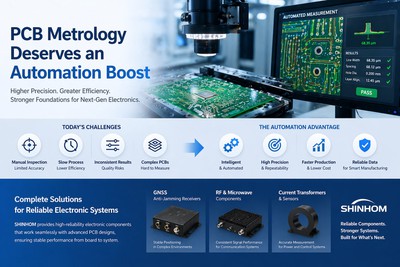
Industry Insight: PCB Inspection Is Lagging Behind Production Innovation
While PCB fabrication technologies have advanced rapidly, metrology and inspection processes have not evolved at the same pace.
Current challenges include:
- Manual or semi-automated inspection processes
- Limited measurement speed and scalability
- Inconsistent accuracy across production batches
- Difficulty handling high-density and multilayer PCBs
As board complexity increases, even small measurement errors can lead to:
- Signal integrity issues
- Power instability
- Reduced product reliability
Why Automation in PCB Metrology Is Critical
The push toward automation is driven by several key factors:
1. Increasing PCB Complexity
Modern PCBs feature finer traces, higher layer counts, and tighter tolerances, requiring more precise measurement.
2. Demand for High Production Efficiency
Manufacturers need faster inspection processes without compromising accuracy.
3. Need for Data Consistency
Automated systems ensure repeatable and reliable measurement results across large production volumes.
4. Integration with Smart Manufacturing
PCB metrology must align with Industry 4.0, enabling real-time data analysis and process optimization.
The Hidden Link: Component Performance and PCB Accuracy
While metrology focuses on PCB fabrication, there is another critical factor often overlooked:
👉 The performance of electronic components mounted on the PCB.
Even with perfect PCB design and inspection, system reliability can still be affected by:
- Signal distortion from unstable RF components
- Inaccurate sensing due to low-quality transformers or sensors
- Interference issues in GNSS and communication modules
This highlights an important reality:
👉 PCB precision and component quality must work together to ensure system performance.
SHINHOM Solutions for High-Reliability Electronic Systems
As PCB manufacturing moves toward higher precision and automation, SHINHOM provides reliable electronic components designed to match these evolving requirements.
Key Product Areas:
GNSS Anti-Jamming Receivers
Ensure stable positioning and signal integrity in complex environments
RF and Microwave Components
Deliver consistent signal performance for communication systems
Current Transformers and Sensors
Provide accurate measurement and monitoring for power systems
These components are engineered to support high-density PCB designs, offering:
- Stable electrical performance
- Strong anti-interference capability
- High reliability under demanding conditions
Application Scenarios in Advanced PCB Systems
SHINHOM components are widely used in applications where PCB precision and system stability are critical:
- Industrial automation systems
- Communication infrastructure
- UAV and autonomous platforms
- Power electronics and energy systems
In these applications, component consistency is just as important as PCB accuracy.
Looking Ahead: From Measurement to System-Level Optimization
The evolution of PCB metrology reflects a broader industry shift:
👉 From component-level inspection
👉 To system-level performance optimization
Automation in PCB inspection will improve manufacturing precision-but achieving true system reliability also requires high-quality, stable electronic components.
Conclusion
As PCB metrology enters a new phase of automation and intelligence, manufacturers must look beyond inspection alone.
Combining advanced PCB measurement technologies with reliable electronic components is the key to building high-performance, future-ready systems.
SHINHOM continues to support this transformation by delivering components that meet the demands of modern, high-precision electronics manufacturing.