




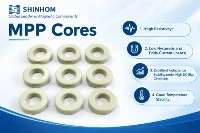
As a Toroidal Choke factory and circuit designer you must deal with many types of noise: internal noise, external noise, RF noise, line frequency noise, and so on. Regardless of its type or source, noise can be a limiting factor in system performance and must be addressed and minimized. The noise reduction challenge usually boils down to the following "How much effort and cost is required?
Even the ubiquitous switched-mode power supply (SMPS) has noise issues. Due to its efficiency and small size, this architecture is widely used in applications including LED drivers and electronic ballasts. Unfortunately, SMPS units also are subject to differential mode (DM) noise and common mode (CM) noise, both of which must be suppressed for both performance and regulatory reasons.
Understand the Noise Mechanisms and Solutions
Differential mode and common mode noise have different causes and thus different solutions. Differential mode noise is noise that is conducted on the line and neutral in opposite directions (Figure 1, right). The basic DM filter uses a single-winding choke (inductor) inserted into the line path, along with a capacitor from line to neutral, thus blocking noise from propagating through the system.
Differential-mode noise arises from voltage fluctuations between the power line and the neutral line, manifesting as currents flowing in opposite directions on the two lines (such as during switching transients in switching power supplies). Common-mode noise, on the other hand, is generated by parasitic capacitance coupling or electromagnetic interference between the lines and ground, with currents flowing in the same direction on both lines (such as leakage currents to ground from high-frequency switching devices). Their spectral distributions differ: differential-mode noise is concentrated mainly in the low-frequency range (e.g., switching frequencies and their harmonics), while common-mode noise typically occurs in the high-frequency range (e.g., MHz levels).
Limitations of Traditional Suppression Solutions
The complexity of discrete filters: Traditional methods require separate designs for differential-mode inductors (single-winding) and common-mode inductors (double-winding), combined with X-capacitors (across-the-line capacitors) and Y-capacitors (line-to-ground capacitors) to form an LC filter network. This not only occupies PCB area but also increases costs and reliability risks due to the high number of components.
Core coupling issues: In discrete designs, the magnetic flux of the differential-mode inductor may interfere with the common-mode inductor, especially in compact layouts, leading to degraded filter performance.
Integrated Design Structure and Operating Principle of Dual-Function Chokes
Dual-function chokes utilize core-sharing technology, designing two sets of windings on the same magnetic core: one for the differential-mode inductor (single-winding) and the other for the common-mode inductor (double-winding). By optimizing the number of winding turns and core material (such as high-permeability ferrite), simultaneous suppression of both noise modes is achieved within a single component. For instance:
Differential-mode path: The single-winding inductor is series-connected in the line to suppress high-frequency components of differential-mode currents.
Common-mode path: The double-winding inductor blocks the flow of common-mode currents through the principle of magnetic flux cancellation.
Performance Advantages
Space and cost optimization: The integrated design reduces PCB area occupation by 30%-50% and simplifies the bill of materials (BOM).
Enhanced high-frequency suppression capability: By optimizing the frequency response of the core material (such as nanocrystalline alloy), a wider frequency range (typical range: 150kHz-30MHz) can be covered, meeting EMC standards such as CISPR 32.
Improved thermal management: Shared cores reduce thermal resistance, making them suitable for high-power-density scenarios (such as electric vehicle charging modules).
Application Cases and Measured Data
LED Driver Power Supply Case
In a 100W LED driver, replacing traditional discrete filters with dual-function chokes resulted in:
Conducted noise reduction: Differential-mode noise attenuation reached 40dB@1MHz, and common-mode noise attenuation reached 35dB@5MHz (complying with FCC Part 15 Class B limits).
Efficiency improvement: Overall efficiency increased by 0.8% due to reduced core losses.
Technical Evolution Directions
Adaptation to wide-bandgap semiconductors: In response to the high switching frequencies (>1MHz) of GaN/SiC devices, ultra-high-frequency-response integrated chokes (such as thin-film magnetic materials) are being developed.
Intelligent filtering: Integrating current sensors and adjustable inductors for dynamic noise suppression (e.g., adaptive filtering based on AI algorithms).
Conclusion
Dual-function chokes, through structural innovation and material optimization, address the issues of large size, high cost, and design complexity of traditional EMI filters, particularly suitable for space-constrained high-density power systems (such as 5G base stations and new energy vehicle electronics). In the future, with the proliferation of third-generation semiconductor technology, such integrated components will become core devices for efficient noise management.