

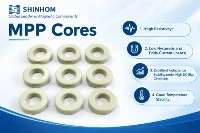



In applications such as PFC inductors, high-Q filters, and buck-boost inductors, the selection of core material directly determines circuit efficiency, stability, and reliability. MPP Cores are made from an alloy powder of 17% Fe, 81% Ni, and 2% Mo, and are known for having the lowest core loss and the best temperature stability.But when faced with different circuit requirements, how do you select the most suitable MPP Core?
1. Four Key Selection Factors
1. Core Loss
- MPP Cores have the lowest loss among various core materials
- Low hysteresis loss + low eddy current loss
- Suitable for applications with extremely high efficiency requirements
- Selection Recommendation: Prioritise loss specifications, especially in PFC inductor and high-frequency filtering applications.
2. Temperature Stability
- MPP Cores offer the best temperature stability
- Minimal inductance variation across a wide temperature range
- Suitable for operating environments with large temperature fluctuations
- Selection Recommendation: For high-temperature or wide-temperature applications, prioritise MPP to ensure stable inductance values.
3. DC Bias Characteristics
- Excellent inductance stability under high DC bias
- Not easily saturated under high-current conditions
- Suitable for high-current scenarios such as PFC inductors and buck-boost inductors
- Selection Recommendation: Confirm the circuit's maximum DC bias current and select the corresponding permeability grade.
4. Resistivity
- MPP Cores have high resistivity
- Effectively reduces eddy current loss
- Suitable for high-frequency applications
- Selection Recommendation: For high-frequency scenarios, prioritise models with high resistivity.

2. Application Matching Recommendations
| Application | Key Selection Focus | Matching Rationale |
|---|---|---|
| PFC Inductor | Low loss, high DC bias stability | PFC circuits require low loss and high saturation characteristics |
| High-Q Filter | Temperature stability, low loss | Filters require stable Q factor and low insertion loss |
| Buck-Boost Inductor | High DC bias stability | Inductance must remain stable under high-current conditions |
| Electrical Noise Filter | Low loss, high resistivity | Low-loss filtering required across a wide frequency range |
3. Selection Considerations
- Permeability selection: Choose the appropriate permeability based on inductance requirements and DC bias current
- Size selection: Determine core size based on PCB space and winding requirements
- Coating selection: Choose the appropriate coating based on insulation requirements
- Temperature confirmation: Confirm whether the operating temperature range covers the actual environment
- Frequency confirmation: Confirm whether the operating frequency falls within the material's applicable range
4. Customisation Capabilities
SHINHOM supports customisation services for MPP Cores:
- Core size customisation: Adjusted according to customer installation space
- Permeability customisation: Adjusted according to circuit requirements
- Coating customisation: Selected based on insulation and temperature resistance requirements
- Performance parameter customisation: Loss and stability optimised for specific applications

5. Conclusion
When selecting MPP Cores, the key is to balance four parameters: core loss, temperature stability, DC bias characteristics, and resistivity.
- PFC Inductor: Prioritise low loss and high DC bias stability
- High-Q Filter: Prioritise temperature stability and low loss
- Buck-Boost Inductor: Prioritise high DC bias stability
- Noise Filter: Prioritise low loss and high resistivity
For selection recommendations or customised solutions based on your specific circuit parameters, please contact our technical team.
📧 Email: sales@shinhom.com
🌐 Website: www.shinhom.com/
🔗 Product Details & Inquiries: MPP Cores