

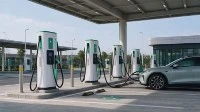
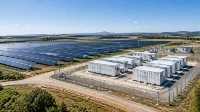

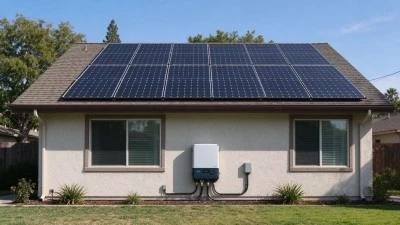
New energy vehicles and renewable energy generation are reshaping the power electronics industry at an unprecedented pace – EV charging station power is advancing from 60kW to over 350kW, and photovoltaic inverters continue to evolve towards higher power density and higher efficiency. These applications place greater current, higher temperature, and more stringent reliability requirements on power inductors. SHINHOM Flat Wire Inductors are precisely the inductor solution offered for high-power-density applications in new energy and automotive electronics.
Trend 1: Greater Current Carrying Capability
Trend Requirements
- EV charging station power levels continue to rise, with output currents reaching hundreds of amperes
- PV inverters and on-board DC-DC converters are driving increased demand for high-current inductors
- Traditional round-wire inductors have relatively high DCR under high current, making loss and heat generation a bottleneck
Suitability of Flat Wire Inductors
- Flat wire winding increases the effective cross-sectional area, achieving lower DCR in the same volume
- DEP series current range from 17.5A to 80A; LPQ/SPQ series saturation current exceeds 100A
- Alloy metal die-cast cores provide soft saturation characteristics, with inductance declining gradually under high current, avoiding system instability caused by sudden drops
- Core posts allow arbitrary air gap adjustment, enabling greater current surge capability
Trend 2: Higher Operating Temperatures
Trend Requirements
- EV charging stations are deployed outdoors, where summer heat and direct sunlight raise internal temperatures
- PV inverters operate outdoors long-term, with wide temperature variations
- On-board DC-DC converters are located near the engine or power modules, where ambient temperatures are high
Suitability of Flat Wire Inductors
- DEP series operates at temperatures up to 180°C, adapting to high-temperature environments
- TR series operating temperature range of -40°C to +155°C, meeting automotive-grade requirements
- Class C AIW enamelled wire: solvent-resistant, thermally stable, radiation-resistant, and freeze-resistant
- Surface coating treatment provides excellent insulation performance, improving reliability at high temperatures
Trend 3: Lower DCR and Better Heat Dissipation
Trend Requirements
- High-power-density designs require lower conduction loss and higher conversion efficiency
- Limited heat dissipation space means the inductor's self-heating must be kept within a reasonable range
- Flat wire winding must balance low loss with a good thermal conduction path
Suitability of Flat Wire Inductors
- Flat wire is tightly wound with flat inter-turn surfaces, fully utilising the limited assembly space of the core
- DCR as low as 0.3mΩ (DEP2520 series), significantly reducing copper loss
- The flat wire structure facilitates heat conduction along the winding axis, providing better heat dissipation than round wire
- Magnetic shielding reduces leakage flux and interference with surrounding circuits
Trend 4: Automotive-Grade Certification and High Reliability
Trend Requirements
- Automotive electronics must pass AEC-Q200 certification to ensure long-term reliability
- EV charging stations and PV inverters must meet industrial-grade reliability and safety standards
- High-low temperature cycling, vibration, and humid environments pose challenges to inductor consistency
Suitability of Flat Wire Inductors
- TR series is AEC-Q200 Grade 1 certified, suitable for EV charging stations and PV inverters
- Alloy die-cast core structure provides excellent mechanical strength and thermal stability
- Pins are directly led out as soldering terminals, completely preventing open-circuit failure
- Special core air gap structure prevents sudden inductance drop even when current exceeds the rated level, preventing a series of problems caused by current overload
Application Scenarios
| Application Scenario | Current Requirement | Temperature Requirement | Recommended Series | Matching Rationale |
|---|---|---|---|---|
| EV charging stations | Tens to hundreds of amperes | -40°C to +155°C | TR series | AEC-Q200 certified, flat wire low DCR, suitable for high-power charging modules |
| PV inverters | Tens to over a hundred amperes | -40°C to +155°C | TR series | AEC-Q200 certified, suitable for boost and output filtering |
| On-board DC-DC converters | Tens of amperes | -40°C to +180°C | DEP series | High-temperature operation, soft saturation characteristics, suitable for vehicle power supplies |
| Industrial power supplies | Tens to over a hundred amperes | -40°C to +180°C | DEP/LPQ series | High current, high temperature, low DCR |
Conclusion: Providing High-Power-Density Inductor Solutions for New Energy and Automotive Electronics
Flat Wire Inductors feature flat wire winding to reduce DCR, alloy core soft saturation characteristics, high-temperature operation up to 180°C, and AEC-Q200 automotive-grade certification for the TR series. They are suitable for high-power-density applications such as EV charging stations, PV inverters, on-board DC-DC converters, and industrial power supplies.
For selection recommendations or to request samples based on your specific application (current requirements, operating temperature, certification requirements), please contact our technical team.
📧 Email: sales@shinhom.com
🌐 Website: www.shinhom.com/
🔗 Product Details & Inquiries: Flat Wire Inductor