


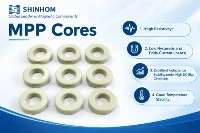


In the EMI filter design of high-frequency switch-mode power supplies (SMPS), electric vehicle onboard chargers (OBCs), and photovoltaic inverters, engineers often face a critical choice: continue using proven ferrite common-mode chokes, or adopt higher-performance nanocrystalline cores at a modestly higher cost.
When radiated emissions repeatedly exceed limits in the 30–100 MHz range, when common-mode inductance drops significantly at elevated temperatures, or when filter size is constrained by increasingly compact enclosures, the answer often points toward nanocrystalline cores technology.

1. Key Performance Comparison: Nanocrystalline Cores vs. Ferrite
| Parameter | Ferrite (MnZn) | Nanocrystalline Cores(N80 Series) | Engineering Significance |
|---|---|---|---|
| Permeability (μ) @ 10 kHz | 3,000–15,000 | >80,000 | Higher permeability requires fewer turns for the same inductance, reducing copper losses and component size. |
| Saturation Flux Density Bs (T) | ~0.5 | ~1.25 | Higher Bs improves resistance to DC bias saturation and supports higher current applications. |
| Curie Temperature (°C) | 120–300 | >560 | Higher thermal stability enables reliable operation in automotive and outdoor environments. |
| High-Frequency Loss @ 1 MHz | High | Low | Lower core loss reduces heat generation and improves overall system efficiency. |
| Size / Weight (for Equivalent Inductance) | Baseline | 50–70% Smaller | Significant advantage in compact designs with limited PCB space. |
| Temperature Stability | Moderate (noticeable permeability reduction between -40°C and 85°C) | Excellent (inductance variation <15% from -55°C to 150°C) | Suitable for automotive electronics, outdoor base stations, and other harsh environments. |
2. Which Applications Require Nanocrystalline Cores?
Application 1: Common-Mode Filtering in SMPS
Challenge:
Conducted EMI exceeds regulatory limits in the 1–30 MHz range, while ferrite impedance tends to decrease at higher frequencies.
Nanocrystalline Cores Advantage:
- High impedance across a wide frequency range (10 kHz–100 MHz)
- Single-stage filtering can meet CISPR 22 Class B requirements
- More than 50% reduction in filter volume
Application 2: EV Onboard Chargers (OBC) and Charging Stations
Challenge:
AEC-Q200 automotive requirements demand reliable operation from -40°C to +125°C. Ferrite inductance can decrease by more than 30% at elevated temperatures, leaving insufficient EMI margin.
Nanocrystalline Cores Advantage:
- Curie temperature above 560°C
- Inductance variation below 15% across a wide temperature range
- Reduced need for excessive design margins

Application 3: Photovoltaic Inverters and Energy Storage PCS
Challenge:
As switching frequencies move toward 100 kHz and beyond, ferrite core losses increase significantly, resulting in higher operating temperatures.
Nanocrystalline Cores Advantage:
- Core loss at 1 MHz is approximately one-fifth that of ferrite
- Temperature rise reduced by 15–20°C
- Improved conversion efficiency
3. Key Features and Customization Capabilities of the Shinhom N80 Series
| Model | Dimensions (OD × ID × H, mm) | Permeability (μ) | AL Value (nH/N²) | Current Range |
| N80-2010 | 20 × 10 × 10 | 80,000 | 4,500 | 2–5 A |
| N80-2512 | 25 × 12 × 12 | 80,000 | 6,800 | 5–10 A |
| N80-3216 | 32 × 16 × 16 | 80,000 | 12,000 | 10–20 A |
| Custom | Any Size | Adjustable | Custom | Custom |
Key Capabilities
- Low-profile designs (minimum height: 5 mm) for space-constrained PCBs
- Wide operating temperature range: -55°C to +150°C
- Compliance with AEC-Q200 automotive standards
- Customizable dimensions, turns count, and pin configurations
4. When Should You Keep Ferrite-and When Should You Upgrade?
| Design Requirement | Recommended Core Material | Reason |
| Low frequency (<100 kHz), low power (<50 W), highly cost-sensitive | Ferrite | Cost-effective and adequate for the application |
| High frequency (100 kHz–100 MHz), high current (>5 A), wide temperature range (-40°C to +125°C) | Nanocrystalline Cores | Superior performance across all key metrics |
| Limited PCB area or height <10 mm | Nanocrystalline Cores | Smallest size for a given inductance value |
| Compliance with CISPR 25 Class 5 automotive standards | Nanocrystalline Cores | Wideband impedance and excellent temperature stability |
Summary
If your design involves high frequencies, high currents, wide temperature ranges, or severe space constraints, nanocrystalline cores represent the more future-proof engineering solution.
5. How to Obtain Samples and Technical Support
Shinhom provides the following support services for its N80 Series nanocrystalline cores common-mode choke solutions:
Free Samples
Standard models can be requested online and are typically shipped within 2–3 business days.
Custom Design Support
Provide your operating frequency, current requirements, and dimensional constraints, and Shinhom engineers will deliver a feasibility assessment within 24 hours.
Engineering Data
- Available upon request:
- Impedance-versus-frequency curves
- Thermal performance and temperature-rise reports
- Application-specific design recommendations
Mass Production Capability
Manufactured on IATF 16949-certified production lines with annual production capacity reaching several million units.
📧 :sales@shinhom.com
🌐 :www.shinhom.com