



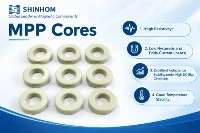

As global industries push the boundaries of miniaturization and energy efficiency, MnZn ferrite cores have emerged as critical enablers for advanced power conversion and electromagnetic interference (EMI) management. These precision-engineered components, synthesized from manganese oxide (MnO) and zinc oxide (ZnO), are redefining performance benchmarks in high-frequency electronic systems.
Material Innovation and Functional Advantages
MnZn ferrite cores leverage optimized ceramic processing techniques to achieve superior magnetic properties:
Low Hysteresis Loss: Minimizes energy dissipation during rapid magnetization cycles, enhancing thermal stability.
High Resistivity: Reduces eddy current losses, enabling efficient operation at elevated frequencies.
Controlled Permeability: Maintains consistent magnetic flux density across dynamic operating conditions.
The unique spinel crystal structure of MnZn ferrites ensures balanced magnetic anisotropy, making them indispensable for applications demanding precision and reliability.
Strategic Applications Across Industries
1. Power Electronics
MnZn ferrite cores serve as the backbone of:
High-Frequency Transformers: Enabling compact switch-mode power supplies (SMPS) for renewable energy inverters and EV charging systems.
Planar Inductors: Reducing footprint in GaN- and SiC-based DC-DC converters for 5G base stations and industrial drives.
2. EMI Suppression
Common Mode Chokes: Filtering electromagnetic noise in automotive CAN bus networks and data center server racks.
Broadband Filters: Attenuating unwanted harmonics in IoT device RF circuits.
3. Wireless Power Transfer
Facilitating resonant inductive coupling in contactless charging pads for consumer electronics and medical implants.
Manufacturing Excellence
The production of MnZn ferrite cores involves:
Precision Material Formulation: Calcining iron oxide, manganese oxide, and zinc oxide precursors at controlled stoichiometric ratios.
Advanced Sintering: Achieving uniform grain growth through atmosphere-regulated kiln processes.
Surface Finishing: Applying insulating coatings to prevent inter-turn short circuits in wound components.
This ceramic-based fabrication approach ensures batch-to-batch consistency while meeting stringent RoHS and REACH compliance standards.
Addressing Modern Engineering Challenges
As electronics migrate toward MHz-range operation, MnZn ferrite cores provide critical solutions:
Thermal Management: Intrinsic low-loss characteristics reduce heat generation in densely packed PCBs.
Frequency Scalability: Stable permeability from 1 kHz to 10 MHz supports multi-band wireless systems.
Size Optimization: High saturation flux density allows core volume reduction without sacrificing performance.
Sustainability-Driven Innovations
Manufacturers are advancing eco-conscious practices:
Closed-Loop Recycling: Reclaiming post-production ferrite materials for reuse in lower-tier applications.
Energy-Efficient Kilns: Reducing carbon footprint via regenerative thermal oxidation systems.
Lead-Free Processing: Eliminating hazardous substances from binder formulations.
Emerging Technological Frontiers
Three trends are reshaping MnZn ferrite applications:
AI-Optimized Core Geometries: Machine learning algorithms designing 3D-printed cores for customized B-H curves.
Multi-Material Integration: Hybrid structures combining ferrites with polymer composites for vibration-resistant inductors.
Quantum-Era Readiness: Ultra-stable cores for cryogenic superconducting magnetic energy storage (SMES) systems.
Market Outlook
The MnZn ferrite core sector is projected to grow at 8.4% CAGR through 2030, driven by:
EV Proliferation: 300% increase in demand for onboard charger components.
6G Infrastructure Development: Terahertz-frequency EMI control requirements.
Industrial Automation: Surge in robotic systems requiring compact power modules.