




When designing RF power amplifiers, wireless communication modules, or broadband filters, the choice of inductor can directly affect signal quality and overall system performance.Engineers often face a common question:Should they choose an air-core inductor for higher Q factor and better linearity, or a magnetic-core inductor for higher inductance in a limited space?Is it possible to achieve high Q, high current capability, compact size, and excellent consistency at the same time?SMD air-core RF inductors provide an effective solution. Below are four common design challenges and the recommended solutions.
Challenge 1: Why Do Magnetic-Core Inductors Struggle in High-Power RF Applications?
Typical Situation:A magnetic-core inductor performs well during low-power testing. However, when RF power increases, spurious signals appear and system efficiency drops.
Root Cause:High-frequency, high-current operation can drive the magnetic core into saturation.
When saturation occurs:
- Inductance decreases significantly
- Q factor deteriorates
- Signal distortion increases
- Power loss and heat generation rise
Advantage of Air-Core Inductors
Air-core inductors contain no magnetic core.As a result:
- No core saturation
- No core loss
- Stable inductance under high current
- Reduced signal distortion
Recommended Products
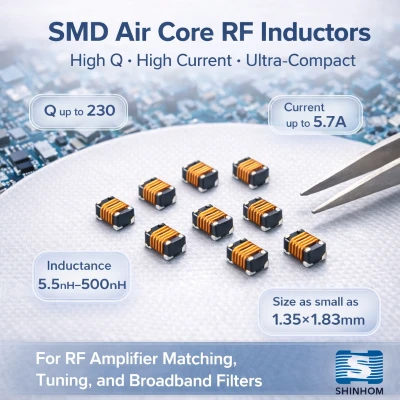
- SMAR1812 (3.3 nH to 150 nH, Q factor above 100)
- SMAR05 Series (27 nH to 500 nH, Q factor up to 230)
Challenge 2: How Important Is the Q Factor?
Typical Situation:Many engineers know that a higher Q factor is desirable, but may not fully understand its impact on circuit performance.
Why It Matters:
A higher Q factor means lower equivalent series resistance (ESR).Benefits include:
- Lower power loss
- Better frequency selectivity
- Improved signal quality
- Reduced noise
Recommended Products
- SMAR0570 (90 nH to 300 nH, current up to 5.7 A, Q factor 140–230)
- SMAR3848 (22 nH to 120 nH, Q factor around 100)
Challenge 3: Does a Difference of Just 1 nH Really Matter?
Why It Matters:In high-frequency circuits, even a small inductance variation can significantly affect performance.For example:
- A 1 nH deviation may shift a VCO frequency by several MHz.
- A narrowband filter may become detuned.
Advantage of Air-Core Inductors
SHINHOM air-core inductors are available with ±2% tolerance options.Benefits include:
- Better accuracy
- Improved lot-to-lot consistency
- More stable RF performance
Recommended Products
All SMAR Series inductors support ±2% tolerance options. High-precision versions are recommended for frequency-sensitive circuits.
Challenge 4: How Can You Save PCB Space Without Sacrificing RF Performance?
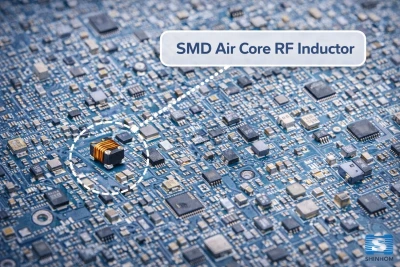 Typical Situation:Portable and compact electronic devices often have very limited PCB space.
Why Size Matters
- Save board space
- Shorten signal paths
- Reduce unwanted parasitic effects
- Improve overall circuit layout
Recommended Products
SMAR1814
- Size: 1.35 × 1.83 mm
- Smallest package available
- Ideal for compact portable devices
SMAR0540
- Size: 2.67 × 2.67 mm
- Balanced size and performance
SMAR1210 / SMAR1812
- Standard package sizes
- Suitable for general PCB designs
Quick Selection Guide
Series | Inductance Range | Typical Q Factor | Max Current | Package Size | Recommended Applications |
|---|---|---|---|---|---|
SMAR1814 | 5.5–22 nH | 50–100 | 1.6 A | 1.35 × 1.83 mm | Ultra-compact portable devices, Bluetooth products |
SMAR1812 | 3.3–150 nH | >100 | 1.6–3.5 A | 4.9 × 3.5 mm | General RF matching, broadband filters |
SMAR05 Series (0540, 0550, etc.) | 27–500 nH | 120–230 | 4.0–5.7 A | Starting from 2.67 × 2.67 mm | High-performance PA matching, VCOs, high-Q applications |
SMAR0570 / 0580 | 90–500 nH | 140–230 | 5.7 A | Starting from 5.21 × 5.46 mm | High-current, high-power RF applications |
SMAR3848 | 22–120 nH | Around 100 | 3.0–3.5 A | 3.81 × 4.20 mm | Balanced performance and size |
SMAR6310 | 90–538 nH | 87–95 | 2.0–3.5 A | 6.35 × 5.90 mm | Applications requiring higher inductance values |
Selection Tips
Step 1: Determine the Required Inductance
Calculate the required inductance value based on operating frequency and matching or resonance requirements.
Step 2: Evaluate Q Factor and Current Rating
Step 3: Consider Size and Tolerance
📧 :sales@shinhom.com
🌐 :www.shinhom.com