




Switch Mode Transformers, critical components in power supply systems, are driving advancements across industries by enabling compact, energy-efficient solutions for high-frequency switching applications. As the demand for smaller, lighter, and more efficient electronic devices grows, these transformers have become indispensable in applications ranging from consumer electronics and renewable energy systems to industrial automation and electric vehicle (EV) charging infrastructure. By optimizing energy conversion with minimal losses, Switch Mode Transformers are reshaping how modern power architectures balance performance, sustainability, and cost-effectiveness.
Transformer technology is undergoing rapid evolution. Engineers are now challenged to balance efficiency, thermal performance, electromagnetic compatibility, and miniaturization while meeting increasingly demanding application requirements.
The Evolution of Switching Power Supply Transformers
From Traditional Wound Transformers to High-Frequency Planar Designs
Conventional switching transformers typically employ ferrite cores wound with copper wire and operate between 50 kHz and 200 kHz. The adoption of GaN and SiC devices has pushed switching frequencies to 500 kHz–2 MHz and beyond, creating new opportunities and new design challenges.
Higher switching frequencies provide two major advantages:
- Reduced transformer turns count and smaller magnetic core dimensions, enabling more compact designs.
- Increased power density through smaller passive components.
However, higher frequencies also intensify skin effect and proximity effect losses, while core losses rise significantly. As a result, loss management becomes a key aspect of transformer design.
To address these challenges, planar transformers replace traditional wire windings with multilayer PCB windings and flat magnetic cores. Compared with conventional wound transformers, planar designs offer:
- Lower leakage inductance
- Improved thermal dissipation
- Better manufacturing consistency
- Reduced profile height
Today, planar transformers are widely used in GaN fast chargers, electric vehicle onboard chargers, server power supplies, and high-density DC-DC converters.
Four Major Design Challenges
1. High-Frequency Losses and Magnetic Material Selection
As switching frequencies move toward the MHz range, conventional ferrite materials experience increased losses and reduced permeability. Selecting the right magnetic material becomes critical for balancing efficiency, thermal performance, and cost.
Common material choices include:
| Core Material | Frequency Range | Key Advantages |
|---|---|---|
| MnZn Ferrite | 100 kHz–500 kHz | High saturation flux density, excellent cost-performance ratio |
| NiZn Ferrite | 500 kHz–2 MHz | High resistivity, low eddy-current losses |
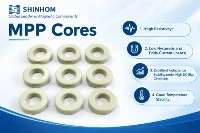
| Amorphous & Nanocrystalline Materials | High-frequency, high-power applications | Extremely low losses, high permeability, minimal temperature rise |
Choosing the appropriate core material can significantly improve efficiency while reducing thermal stress.

2. Winding Loss Reduction
At high frequencies, current concentrates near the conductor surface, reducing the effective conductive area. Combined with proximity effects, winding losses can increase substantially.
Common industry approaches include:
- Litz wire
- Copper foil windings
- PCB planar windings
Shinhom planar transformers utilize interleaved multilayer PCB winding structures that reduce proximity effects and improve winding utilization compared with conventional transformer designs.
3. Leakage Inductance and EMI Control
Excessive leakage inductance can generate voltage spikes, increase switching losses, and contribute to electromagnetic interference (EMI).
Planar transformers naturally provide tighter magnetic coupling between primary and secondary windings. Leakage inductance can typically be controlled to less than 0.2% of primary inductance, reducing the need for additional filtering components and improving overall converter efficiency.
Customized winding structures are also available for application-specific EMI and transient performance requirements.
4.Thermal Management and Integrated Design
As power density increases, thermal management becomes increasingly important.
Compared with traditional vertical wound transformers, planar transformers feature:
- Larger surface contact area
- Improved heat spreading
- Better integration with heatsinks and thermal interfaces
Shinhom products utilize high-thermal-conductivity insulating materials and support operating temperatures from -40°C to +130°C, making them suitable for automotive and industrial environments.
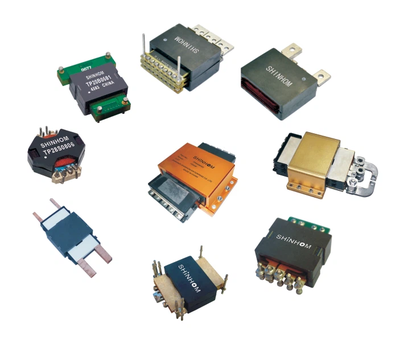
Shinhom Switching Transformer Product Portfolio
| Product Family | Typical Power Range | Operating Frequency | Key Features | Typical Applications |
|---|---|---|---|---|
| High-Frequency Transformer | 10 W–300 W | 50 kHz–500 kHz | Optimized ferrite cores, low leakage inductance, reinforced isolation | AC-DC adapters, auxiliary power supplies, industrial controls |
| Planar Transformer | 50 W–3 kW | 100 kHz–1 MHz | 98–99% efficiency, leakage inductance ~0.2%, profile height <12 mm, low EMI | GaN chargers, OBCs, DC-DC converters, server power supplies |
| Gate Drive Transformer | 1 W–5 W | 50 kHz–1 MHz | 4000 Vrms isolation, AEC-Q200 compliant, push-pull topology | IGBT and SiC MOSFET gate drive systems, isolated power supplies |
| Current Sense Transformer | - | 10 kHz–1 MHz | High accuracy, low phase error, PCB/SMD/split-core options | Current measurement, overload protection, energy monitoring |
| Magnetic Core Materials | - | 100 kHz–2 MHz | Low loss, high permeability, excellent temperature stability, customizable geometries | Transformers, inductors, and magnetic assemblies |
Application Recommendations

1.GaN Fast Chargers (30 W–200 W)
Modern GaN chargers typically require:
- Overall profile below 10 mm
- Efficiency exceeding 96%
- High power density
Planar transformers are often the preferred solution due to their thin PCB-based structure and excellent thermal performance.
2.Electric Vehicle Onboard Chargers (3.3 kW–22 kW)
Automotive OBC systems demand:
- High dielectric withstand voltage
- Wide-temperature operation
- Vibration resistance
- Long-term reliability
Shinhom planar transformers are AEC-Q200 qualified and support operating temperatures from -40°C to +130°C, making them suitable for automotive production programs.
3.Auxiliary Power Supplies in PV and Energy Storage Systems
High-frequency flyback transformers provide a reliable solution for auxiliary power rails, supporting multiple output voltages such as 5 V, 12 V, and 24 V while maintaining robust isolation performance.
4.Server and Industrial Power Supplies
For 1 kW–3 kW power levels, planar transformers offer:
- Efficiency above 98%
- Compatibility with LLC resonant converters
- Support for interleaved power architectures
- Improved thermal performance for high-density designs
These characteristics help power supplies achieve demanding efficiency targets such as 80 PLUS Titanium certification.
Contact us for technical support
📧 : sales@shinhom.com
🌐 : www.shinhom.com
📞 : +86-29-87851838