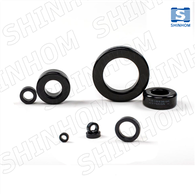
Iron Powder Cores(KT) ✉ are made by pressing high-performance iron powder materials. It features high saturation flux density and excellent DC bias stability, allowing it to maintain inductance without degradation under high-current operating conditions and effectively preventing core saturation.Compared with ferrite cores or laminated metal cores, iron powder cores offer superior performance in noise suppression and energy absorption. In addition, the toroidal closed magnetic circuit structure minimizes electromagnetic radiation to the greatest extent, reducing shielding costs.The product operates over a temperature range of -65°C to +125°C and is available in various material types and permeability options. It is widely used in switching power supply output chokes, PFC inductors, and EMI noise filtering applications.
Features
- High Saturation Flux Density
- Low Core Loss
- Excellent DC Bias Performance
- Wide Permeability Range: from 10μ to 125μ.
- Operating Temperature Range : -65°C to +125°C.
- Toroidal Closed Magnetic Circuit
- Multiple Material Options : Including -2, -8, -26, -52, etc.
- High Cost-Effectiveness :Lower cost compared to MPP and Sendust materials


Applications
- Switching Power Supply Output Chokes
- PFC (Power Factor Correction) Inductors
- EMI Noise Filters
- Pulse Transformers
- DC-DC Converters
- Dimming Circuit Chokes
FAQ
Q: What is the difference between iron powder cores and ferrite cores in high-current applications?
A: Iron powder cores offer a higher saturation flux density, making them less prone to saturation under high-current conditions and eliminating the need for a discrete air gap. In addition, their toroidal structure results in low electromagnetic radiation, providing better noise suppression performance compared to ferrite cores and laminated metal cores.
Q: How should iron powder core materials be selected?
A: The -26 material is the most commonly used option due to its good cost-performance balance and suitability for most power applications. The -8 material offers lower high-frequency losses, while the -52 material is an upgraded version of -26 optimized for higher-frequency operation. Selection should be based on operating frequency, current level, and cost requirements.
Q: Do iron powder cores require an air gap?
A: No. Iron powder cores inherently feature a distributed air-gap structure, allowing them to maintain stable inductance under high DC current conditions while avoiding additional losses and electromagnetic radiation associated with a discrete air gap.
Q: Is there a coating on iron powder cores?
A: Yes. Toroidal iron powder cores are coated with a protective insulation layer, providing a minimum dielectric strength of 600 Vrms @ 50 Hz. Higher insulation ratings can also be customized according to customer requirements.
SHINHOM is dedicated to setting a high bar of excellence for industries that integrate or utilize magnetics technologies in our Iron Powder Cores products.
Hot Tags: iron powder cores, China iron powder cores manufacturers, suppliers, factory, Iron Powder Cores, MPP Cores, Amorphous Powder Core, High Flux Cores, Sendust Cores, Alloy Powder Amorphous Powder Core