




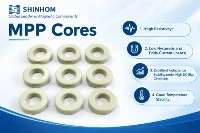
As the demand for high-efficiency power supplies surges across industries, Amorphous Mag-Amp Cores have emerged as a critical enabler of precision post-regulation in multi-output switch-mode power supplies (SMPS). Leveraging the Mag-Amp (Magnetic Amplifier) technique, these cores offer a robust, cost-effective solution for secondary-side voltage control in server, telecom, and personal computing applications. With their unique combination of reliability, noise suppression, and design simplicity, amorphous-based Mag-Amp cores are redefining performance benchmarks in modern power electronics.

Technical Overview: How Amorphous Mag-Amp Cores Work
The Mag-Amp technique utilizes saturable reactors to regulate auxiliary outputs by controlling the magnetic permeability of the core material. Amorphous alloys, characterized by their ultra-thin, non-crystalline structure, provide exceptional magnetic properties:
High Permeability: Enables precise inductance control under varying load conditions, maintaining output voltage stability within ±1% from no-load to full-load states.
Low Core Loss: Amorphous materials reduce eddy current losses by up to 75% compared to traditional ferrites, critical for high-frequency (100kHz–1MHz) SMPS designs.
Fast Magnetic Saturation: Allows rapid response to transient currents, safeguarding output diodes from voltage/current spikes.
Key Advantages Driving Adoption
1. Simplified Circuit Design
By replacing complex semiconductor-based regulation (e.g., MOSFETs) with a passive magnetic component, amorphous Mag-Amp cores reduce control circuit complexity. This eliminates 3–5 ancillary components (e.g., snubbers, drivers), cutting PCB footprint by 20% and accelerating time-to-market.
2. Enhanced Reliability
Amorphous cores withstand instantaneous surges (e.g., 200% overload for 10ms) without performance degradation. Their inherent resistance to thermal aging ensures a lifespan exceeding 15 years under continuous operation at 100°C.
3. Noise Suppression
The high inductance of Mag-Amp cores, when connected in series with output diodes, suppresses reverse recovery noise by 50–60 dB. This contrasts with semiconductor regulators, which introduce switching noise into the control loop.
Procurement Guidelines for Optimal Performance
When sourcing amorphous Mag-Amp cores, engineers and procurement teams should prioritize the following criteria:
1. Material Composition
Verify the use of Fe-based amorphous alloys (e.g., Fe-Si-B) with a saturation flux density (Bs) ≥ 1.5T to ensure compatibility with high-current applications.
Request core loss data at operating frequencies (e.g., 200kHz, 400kHz) to align with SMPS design requirements.
2. Application-Specific Matching
For server/telecom PSUs: Select cores with a permeability range of 10,000–15,000 μi to balance regulation speed and stability.
For consumer electronics: Prioritize compact sizes (e.g., OD 10mm–25mm) and low-profile designs to accommodate space-constrained layouts.
3. Quality Assurance
Insist on cores compliant with AEC-Q200 (automotive) or IEC 62368 (IT/telecom) standards for surge immunity and thermal cycling resilience.
Validate vendor testing protocols for DC bias characteristics (±10% inductance tolerance at H=10 Oe).
Future Trends and Implementation Tips
With the rise of AI-driven power systems and 48V server architectures, amorphous Mag-Amp cores are poised to play a pivotal role in next-gen PSUs. To maximize ROI:
Thermal Management: Pair cores with thermally conductive potting materials (λ ≥ 2.5 W/m·K) to mitigate hotspot formation in high-density designs.
Prototyping Support: Collaborate with suppliers offering custom annealing services to fine-tune core hysteresis loops for target applications.