




*As an SEO specialist in the electronics industry, I've seen countless transformers fail in engine compartments. Today, I'll decode how advanced materials and thermal engineering solve the 125°C challenge – with physics-backed strategies validated by TDK and real-world EV projects.*

🔥 The 125°C Crisis in Automotive Electronics
Three critical failure modes plague transformers in engine bays:
Core saturation
At 125°C, Bs (saturation flux density) drops to 70% of room-temperature value → inductance collapses >20%
Epoxy cracking
CTE mismatch: Copper (18ppm/℃) vs epoxy (60ppm/℃) → delamination risk ↑300% at thermal shock
Copper peel-off
Creep stress >5MPa under high-temperature vibration → winding resistance spikes
Why traditional designs fail:
Standard ferrites (e.g., PC47) show 30% higher losses than PC95 at 100kHz/200mT
Silicone potting cracks at >150°C thermal cycles → coolant leakage in liquid-cooled systems
🛡️ Rule 1: Material Revolution & Structural Optimization
Core Material Showdown (100kHz/200mT)
| Material | Loss @25°C | Loss @125°C | Curie Temp | Cost Impact |
|---|---|---|---|---|
| PC95 | 1.14W/cm³ | 1.14W/cm³ | 220℃ | +15% |
| PC47 | 0.98W/cm³ | 1.30W/cm³ | 210℃ | Baseline |
| Nanocrystalline | 0.45W/cm³ | 0.48W/cm³ | 560℃ | +40% |
Source: TDK Material Datasheet 2022
Epoxy Innovation:
Nano-Al₂O₃ filler: Boosts thermal conductivity from 0.2→1.8W/mK
Step-curing process: 50℃→120℃→150℃ (1h each) reduces bubbles to <0.1%
❄️ Rule 2: Thermal Pathway Design
PCB-Level Heat Drainage
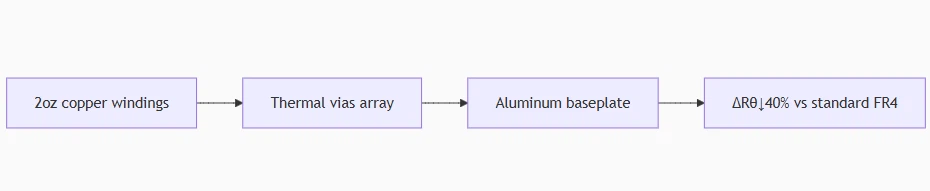
tive Cooling Integration:
Microchannel liquid cold plate:
Contact pressure >20kPa → thermal resistance <0.05℃/W
Flow rate 2m/s achieves 15℃ temperature drop
Phase-change material (PCM):
Metal-enhanced paraffin (k=8W/mK) absorbs 200J/g during IGBT surges
📊 Rule 3: Smart Monitoring & Model Validation
Embedded NTC Sensors:
Buried in secondary windings → ±3% accuracy
Triggers frequency throttling when T>110℃
FEA Simulation Workflow:
| Simulation Target | Tool | Validation Method |
|---|---|---|
| Transient thermal | ANSYS Icepak | IR thermography |
| Thermal stress | COMSOL Multiphysics | X-ray void detection |
| Lifetime prediction | Arrhenius model | 1,000h damp heat test |
⚡ Case Study: 48V Mild-Hybrid DC-DC Converter
Failure mode: Efficiency dropped to 88% @125°C with PC47 core
Solution:
PC95 core + 2oz copper windings
PCM-8F phase-change material on baseplate
Results:
93.2% efficiency @125°C
Passed ISO 16750-4 vibration test (10-500Hz random)
Cost increase: 18% → offset by 30% longer service life
🚀 Future Tech: Beyond Epoxy & Copper
AlN ceramic substrates:
Thermal conductivity >170W/mK (9× higher than epoxy)
3D-printed lattice cores:
50% weight reduction + 2× surface area for convection
AI-driven thermal control:
Real-time loss prediction → dynamic frequency adjustment