

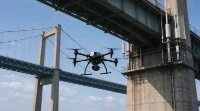



Swarms of robots have been growing in importance due to their flexibility in completing various tasks that are difficult for a single robot or an unmanned aerial vehicle (UAV). Everything from spraying a field with pesticides to forming giant light shows in the sky are easier in groups.
However, their implementation is still limited in dynamic environments due to difficulty navigating around and communicating with each other. Theoretically, having multiple communication network nodes with their own positional sensors would make it easier for members of a swarm to understand and move around that space.
However, implementing the technical features of such a network remains out of reach, due to a lack of a shared framework that allows drones to easily communicate and coordinate with each other. To help address this, researchers from the Shangdong University of Science at Technology summarized over 150 technical papers on "collaborative positioning" for swarms - and here's what they found.
Swarming sensors
Swarms have a wide variety of use cases and can be made up of many different types of system. A single "swarm" network could contain satellites, underwater autonomous vehicles, ground-based vehicles and even handheld networking gear. Understanding precisely where each member of a swarm is remains a difficult challenge, and researching potential solutions to that challenge focuses on the concept of collaborative positioning.
Several technical factors contribute to that challenge, but two of the most difficult to overcome are lack of precise positioning and slow communications speeds. Typical drones will use standard GPS chipsets for their positioning. While they are useful for general positioning, they lack the centimeter-level precision that would be necessary to coordinate exact positions with other drones in the swarm. If, for example, they are attempting to search an area together, there could be a few meters gap in coverage area due to lack of precise positioning.
To alleviate this weakness, the paper looked at different types of sensors that could fuse their data together with one another to create a more wholistic picture of where a drone is located. The different types of sensors can broadly be grouped into three categories - visual, light detection and ranging (lidar) and wireless sensors. Visual is the typical camera system common today on everything from drones to satellites to cell phones. Data these sensors collect help the swarm members understand their immediate surroundings, though they aren't particularly useful in some cases, such as underwater, as the opacity of water limits the transmission of light at wavelengths these sensors can detect.
Wireless sensors are a more nuanced way of measuring distances to different points - especially other members of the swarm itself. Antenna power output and received signal strength can be used as a proxy for distance if a decent model of the media between the two sensors is known and if the two nodes know they are talking to one another. The math for determining distances to several sensors gets complicated quickly, but using this to confirm the distance measurements from other lidar sensors allows individual swarm nodes to complete their overall positioning puzzle.
The future of swarms
That sounds like an opportunity to improve in one of the most important areas regarding autonomous swarms. If we are one day to have a truly autonomous mobility future, with flying cars, delivery drones and dramatically decreased transportation casualties, collaborative positioning will be a critical tool in that environment.
Many long-term capabilities of swarms can only be truly unlocked once they have shared collaborative positioning systems. These range from search-and-rescue missions where thousands of tiny robots' fan out to comprehensively search an area to collaboratively lifting heavy objects that no single node would be able to do by itself.
Humans work best when they are coordinating, and the same can be said for drones and robots. Unlocking a swarm's ability to see the world from literally multiple points of view and coordinating their next actions through a shared wireless communication framework will enable a level of coordination that no human team would ever be able to match.