




As global wireless and microwave communication technologies evolve rapidly, the role of RF passive components has become more important than ever. Passive elements such as inductors, transformers, couplers and attenuators are no longer auxiliary parts - they are core enablers of performance, efficiency and signal integrity in high-frequency systems.
With applications spanning from mobile communications to industrial sensing and RF front-end modules, the demand for optimized RF passive networks continues to grow as designers push toward higher data rates, tighter integration, and broader frequency coverage.
Why RF Passive Components Matter in Modern Electronics
In any radio frequency (RF) or microwave signal chain, numerous passive components work behind the scenes to ensure proper signal conditioning, power distribution and impedance control. Unlike active devices that amplify or process signals, passive components manipulate waveforms without requiring an external power source, relying instead on fundamental electromagnetic behaviour.
Among these, RF inductors are widely used for energy storage, impedance matching, EMI suppression, filtering and oscillation control, all of which are critical in high-frequency design. In tandem with capacitors and resistors, inductors help engineers shape the frequency response and maintain signal integrity across bands ranging from MHz to multi-GHz frequencies.
Other passive elements, such as directional couplers, balun transformers and power splitters, play essential roles in directional signal sampling, balanced-to-unbalanced conversion, and controlled power distribution in complex RF systems.
Trends Driving RF Passive Component Adoption
Several industry trends are placing renewed emphasis on high-performance RF passive networks:
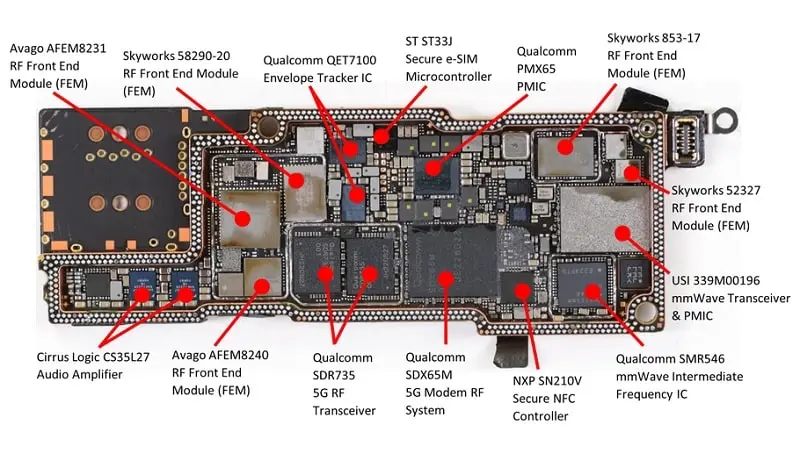
5G and Beyond: The deployment of 5G networks and the anticipated evolution into 6G and mmWave communications demand components capable of operating at much higher frequencies with stable performance and low insertion loss. RF inductors and other passive networks are key to achieving reliable impedance matching and broad bandwidth coverage in these systems.
Automotive Electronics Revolution: Vehicle connectivity features like V2X communication, radar sensing, and infotainment systems all rely on RF modules with passive components designed to handle signal fidelity in challenging noise environments.
Miniaturization and Integration: As devices become smaller and more compact, passive components must also adapt. Multilayer chip inductors and integrated passive networks help designers conserve board space while maintaining high Q factor and low resistance at high frequencies.
These trends reflect a broader shift: as RF systems become more demanding, the traditional view of passive components as "simple parts" is being replaced by an appreciation of their impact on system-level performance.
SHINHOM's RF Passive Solutions for High-Frequency Systems
Recognizing this evolution, SHINHOM has expanded its RF passive component portfolio to address the needs of modern wireless, microwave and industrial RF applications. With optimized designs crafted for MHz to GHz frequency ranges, SHINHOM's components deliver stable electrical performance, low insertion loss, and robust reliability across variable operating conditions.
Key offerings include:
RF Inductors & Chokes: Used for filtering, matching and noise suppression in RF front ends.
Balun Transformers: For balanced-to-unbalanced signal conversion and impedance transformation.
Directional Couplers: Enabling accurate signal sampling and monitoring in high-frequency systems.
Power Dividers & Splitters: Used in distributing RF signals across paths with controlled amplitude and phase.
Integrated Passive RF Networks: Combining multiple passive functions into compact modules for system-level efficiency.
These solutions are suitable for applications such as communication base stations, IoT devices, microwave measurement systems, test benches, industrial RF backbones, and beyond.
Engineering Support for RF System Integration
Beyond off-the-shelf components, SHINHOM also offers custom RF passive network design and integration services. Engineers can collaborate with SHINHOM's technical team to tailor performance parameters, optimize electrical characteristics, and streamline PCB layout strategies for demanding high-frequency designs.
This level of engineering support helps reduce development cycles and improves predictability in production environments, particularly for RF systems where parasitic effects, impedance mismatches, or frequency drift can significantly impact performance.
Looking Ahead: Passive Components in Next-Gen Wireless Systems
As wireless standards continue to evolve and RF applications expand into new domains like autonomous systems, advanced radar, and satellite communications, robust passive components will remain foundational to system success. Rather than being background elements, these parts are increasingly recognized as performance enablers in high-speed, high-frequency designs.
For engineers and system designers looking for reliable RF passive solutions that balance performance, size, and manufacturability, SHINHOM's portfolio presents a compelling choice - combining breadth of options with engineering depth.
Stay tuned to SHINHOM's News & Events section for further product insights and application case studies.