




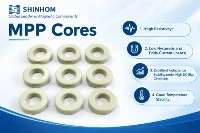
Traditional ferrite cores, once the workhorse of power conversion, begin to falter above 100 kHz. Their core losses can exceed 500 kW/m³ at frequencies as low as 100 kHz, making them unsuitable for modern designs built around GaN and SiC semiconductors. Metal powder cores, by contrast, have emerged as the preferred choice for engineers designing for 5G infrastructure, AI server power delivery, and EV wireless charging systems-applications where thermal stability, saturation current handling, and high‑frequency performance are non‑negotiable.
Today, a growing number of power electronics engineers are moving from generic ferrite solutions to engineered metal powder core inductors that combine predictable electrical parameters, wide‑temperature stability, and real‑world reliability.
The Challenge of Wide‑Band Inductor Selection in Modern Power Systems
In real‑world engineering projects, selecting the right inductor for a wide‑band application is rarely straightforward. Power supply designers, RF engineers, and systems integrators regularly encounter the same recurring frustrations:
- Frequency‑dependent core losses – Traditional ferrites exhibit skyrocketing losses above 100 kHz, forcing engineers to either over‑specify or accept inefficient designs
- Temperature instability – Core permeability drifts significantly across automotive temperature ranges (‑40°C to 150°C), compromising filter tuning and loop stability
- Saturation current limitations – High transient spikes (e.g., 100 A/μs in AI server applications) can drive ordinary cores into hard saturation, causing catastrophic circuit failure
- Size constraints – Modern power modules are packed into ever tighter enclosures, yet traditional inductor solutions require bulky footprints to achieve required ratings
- Manufacturing variability – Particle size distribution, insulation coating uniformity, and pressing parameters all affect final component performance, creating lot‑to‑lot inconsistency
Why Metal Powder Cores Are Gaining Industry Adoption
To address these challenges, the power electronics industry is shifting decisively toward engineered metal powder cores. Instead of accepting the thermal and saturation limitations of ferrites, engineers can now specify metal powder inductors that offer:

- Wide‑temperature stability – Military‑grade Fe‑SiCr cores operate from ‑40°C to 150°C with ±20 ppm/°C drift, critical for EV onboard chargers facing desert heat or Arctic cold
- Superior saturation current handling – Metal powder cores withstand 100 A transient spikes (meeting ISO 16750‑2 standards), protecting downstream SiC MOSFETs in 800 V battery systems
- Controlled high‑frequency losses – Cobalt‑doped Mn‑Zn ferrites now achieve core losses below 150 kW/m³ from 1–3 MHz, finally catching up to GaN switching speeds
- Compact form factors – High‑density metal powder molding enables low‑profile (as low as 3.0 mm) inductors suitable for space‑constrained power modules
- Reduced electromagnetic interference – Uniform powder distribution and optimized winding geometries minimize radiated EMI, simplifying system‑level EMC compliance
Real‑World Impact Across Three Key Applications
- 5G Massive MIMO Antennas
Traditional ferrites cause unacceptable signal distortion above 3.5 GHz. Metal powder inductors (specifically LTCC ferrite cores with optimized compositions) maintain Q > 80 at 6 GHz in compact 3 × 3 × 3 mm packages, enabling dense mmWave base station deployments.
- AI Server Power Delivery
NVIDIA's H100 GPU demands current slew rates up to 1000 A/μs-a condition that quickly saturates conventional inductors. Metal powder cores cut copper losses by 30% compared to ferrite alternatives, preventing thermal throttling during large language model training.
- EV Wireless Charging

By integrating zero‑hysteresis LaCo‑doped metal powder cores, system designers reduce magnetic interference in 11 kW wireless charging systems by 15 dB, eliminating "phantom drain" and improving overall efficiency.
Design Trend: From Generic Components to Application‑Engineered Magnetics
The evolution of magnetic materials mirrors a broader shift observed across power electronics engineering. The focus is moving away from "one‑size‑fits‑all" component selection and toward application‑engineered solutions that address specific system‑level challenges-thermal cycling, transient overcurrents, EMI susceptibility, and board‑space constraints.
As one industry analyst noted, the global inductors market-spanning fixed, tunable, and custom magnetics for automotive, industrial, and renewable energy systems-is projected to grow at a CAGR of 6.8%, reaching nearly USD 9.7 billion by 2032. Within this broader market, tunable and application‑specific inductors are capturing an increasing share, as engineers move away from generic ferrite components toward materials optimized for their specific frequency, current, and temperature requirements.
In sectors where volume production demands repeatability and traceability-automotive power modules, telecom infrastructure, AI compute clusters-this trend has already become standard practice. Leading designers now specify metal powder inductors as the default choice for new wide‑band applications, reflecting an industry consensus that core material selection is too critical to leave to generic catalog parts.
Four Generations of Core Materials: Where Metal Powder Cores Fit
To understand why metal powder cores are gaining industry adoption, it helps to look at the evolution of magnetic core materials.
| Generation | Key Innovation | Limitation | High-Frequency Hero |
|---|---|---|---|
| Ferrites (1980s) | Mn-Zn/Cu-Zn spinel structures | High eddy losses >500kW/m³ @100kHz | N/A (obsolete for MHz apps) |
| Metal Powder Cores (2000s) | SiO₂/Al₂O₃ insulated coatings | Limited temp stability (±50ppm/℃) | 40% lower eddy losses |
| Nanocrystalline (2020s) | Rapid-quenched thin ribbons | Cost prohibitive ($50/kg) | 100kHz loss <350mW/cm³ |
| Hybrid Composites (Now) | Gradient particle sizing (100-400 mesh) | Complex manufacturing | AI-optimized permeability ±0.5% |
Shinhom Metal Powder Core Portfolio: Products You Can Specify Today
| Product Type | Key Characteristics | Typical Applications |
| Iron Powder Cores | >99% pure iron, insulated coating; saturation flux density high; temp range -65°C to +125°C; permeability 10μ–100μ; toroidal shapes minimize EMI | Energy storage inductors, dimming reactors, EMI noise filters, DC output/input filters |
| High Flux Cores (HF) | 50% Fe / 50% Ni; best DC bias capability, 15000 Gauss saturation; low core loss, high energy storage | High‑power, high DC bias: dimming inductors, flyback transformers, PFC inductors |
| Amorphous Choke Cores | Toroidal, gapless construction; low magnetic leakage; superior frequency characteristics | Noise suppression in car audio/navigation, switch‑mode power supplies, DC power line filtering |
Why Choose Shinhom for Your Magnetic Core Needs?
- Complete material portfolio – Iron, alloy (Sendust/High Flux/MPP), amorphous, and nanocrystalline cores-all available from a single supplier
- Wide product shapes – Ring, E, U, R rod, block type, and custom configurations
- Wide temperature range – Most cores operate from -65°C to 125°C; Sendust cores available for 200°C operation
- Proven quality systems – IATF16949 process controls with full material traceability
- In‑stock inventory for standard products – ready to ship to EU, USA, and Russia
- Custom formulation support – Permeability adjustable across wide ranges (26 μ to 125 μ for Sendust; 10 μ to 100 μ for iron powder cores)
- Technical documentation – Complete datasheets and application notes available for download
- Full datasheets with electrical characteristics and core loss curves
- Sample support for prototyping and validation
- Custom permeability or shape configurations for your specific application
- Technical application notes and reference designs
📧 Email: sales@shinhom.com
🌐 Web: www.shinhom.com
👉 Send an Inquiry Now – include your frequency range, current requirement, and thermal operating conditions, and our engineering team will respond with a detailed recommendation within one business day.