


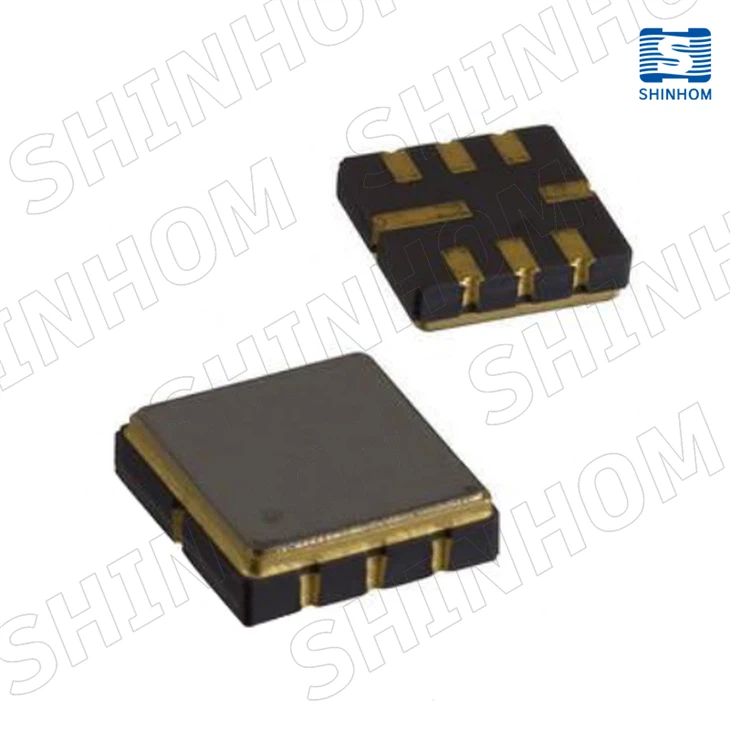
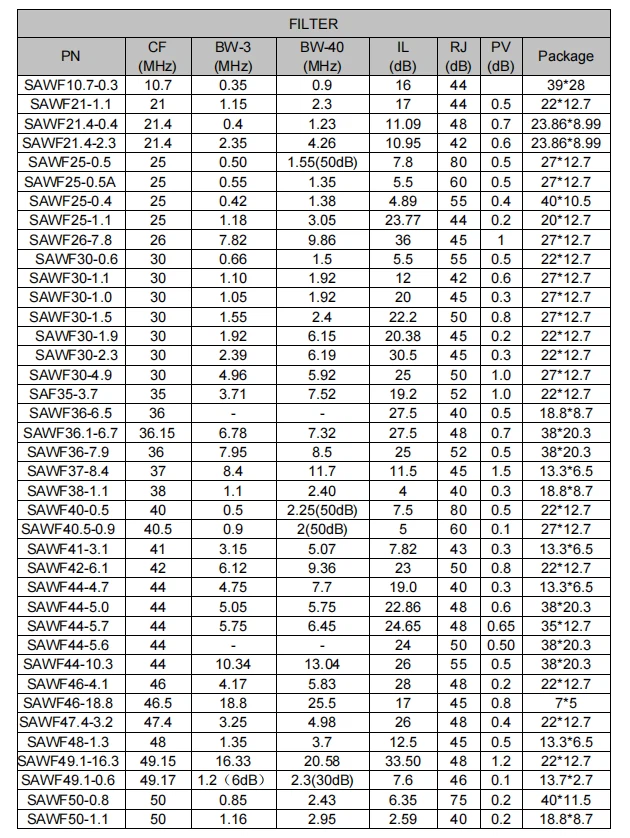
A SAW Filter is highly selective RF filtering devices that convert electrical signals into surface acoustic waves (SAWs) on a piezoelectric substrate and then back into electrical signals for precise frequency selection and unwanted signal suppression.Featuring low insertion loss, high out-of-band attenuation, excellent frequency stability, and compact SMD packages, SHINHOM SAW filters cover center frequencies from 10.7 MHz to 2492 MHz. They are widely used in wireless communications, RF front-end modules, radar systems, satellite communications, broadcasting equipment, and test & measurement instruments.

Features
- High Selectivity
- Low Insertion Loss
- Wide Frequency Range :10.7 MHz to 2492 MHz
- Compact SMD Packages
- High Out-of-Band Rejection :Up to 80 dB
- Excellent Frequency Stability
- Narrow Bandwidth Options : As low as 0.35 MHz
- RoHS Compliant
Applications
- Wireless Communications – Smartphones, base stations, Wi-Fi, and Bluetooth
- RF Front-End Modules – Signal filtering and frequency selection
- Radar Systems – RF signal filtering
- Satellite Communications – Uplink and downlink filtering
- Broadcast Equipment – TV and radio signal processing
- Test & Measurement – Spectrum analyzers and signal analyzers

FAQ
Q: How does a SAW filter work?
A: A SAW filter operates using the piezoelectric effect. Electrical signals are converted into surface acoustic waves by an interdigital transducer (IDT) on a piezoelectric substrate. The acoustic waves propagate across the substrate and are converted back into electrical signals, allowing only the desired frequency band to pass while rejecting unwanted signals.
Q: What are the advantages of SAW filters compared with LC filters?
A: SAW filters offer smaller size, higher selectivity, better manufacturing consistency, and easier integration, making them ideal for high-frequency, narrowband RF applications. LC filters are generally more suitable for low-frequency or wideband applications where cost is a primary consideration.
Q: How do I choose the center frequency and bandwidth?
A: Select the center frequency according to your system's operating frequency and choose the bandwidth based on channel spacing and interference requirements. Narrow bandwidths (e.g., 0.35 MHz) provide excellent selectivity, while wider bandwidths (e.g., 53 MHz) are better suited for broadband communication systems.
Q: Why is out-of-band rejection important?
A: Out-of-band rejection indicates how effectively the filter attenuates unwanted frequencies outside the passband. Higher rejection improves interference suppression, reduces spurious signals, and enhances overall RF system performance.
Contact Us
SHINHOM – Your Trusted SAW Filter Manufacturer & Supplier
📧 Get a Quote | 📋 Request Free Samples | 📞 Inquiry Now
Please specify your required center frequency, bandwidth, and package size. We will reply within 24 hours.
Tel: +86-29-85567686 / +86-29-87851838 | Email:sales@shinhom.com.cn
SHINHOM is dedicated to setting a high bar of excellence for industries that integrate or utilize magnetics technologies in our SAW filter products.
Hot Tags: saw filter, China saw filter manufacturers, suppliers, factory, LTCC Filters, LTCC Triplexer, LTCC Diplexer, Waveguide Components, Microwave Ferrite Cores, Coaxial Line Circulator


