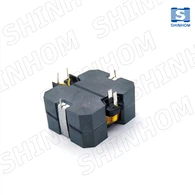
Input & Output Line Reactors for VFD, Inverter and Motor Drive Systems
SHINHOM AC Reactors are designed for inverter and motor drive systems to limit current, suppress harmonics, reduce transient voltage, and improve system stability. Our Input AC Reactors are installed on the inverter input side to reduce inrush and peak current, improve the input current waveform, and restrain grid harmonics. For DC-side filtering applications, SHINHOM also provides DC Reactors for Solar Inverters.
Standard AC reactor solutions are available for 380V and 690V systems, with rated current options from 5A to 1250A depending on voltage, reactor type and voltage-drop requirement. Custom voltage, inductance, dimensions and electrical specifications are available for OEM and application-specific requirements.
Input AC Reactors
AC Line Reactors for VFD and Inverter Input
An Input AC Reactor is installed at the AC input side of a VFD or inverter. It acts as a current-limiting device to reduce inrush and peak current, suppress grid harmonics and improve the input current waveform.
For applications where input power quality and transient protection are important, an AC line reactor provides a simple and reliable solution between the power supply and inverter.
Key Benefits
- Reduces inrush and peak current
- Suppresses grid harmonics
- Improves input current waveform
- Improves real power factor
- Protects AC drives from transient overvoltage
- Provides strong short-time overload capability
- Low DC resistance and low power loss
- Low magnetic flux density and good linearity
Output AC Reactors
AC Output Reactors for VFD and Motor Drives
An Output AC Reactor is installed between the inverter output and motor. It smooths the inverter output waveform and helps reduce transient voltage and dv/dt stress on the motor.
For motor drive systems with long motor cables, high switching frequency or motor noise concerns, an output AC reactor can help reduce motor noise, eddy loss and leakage current caused by high-frequency output harmonics.
Key Benefits
- Smooths the inverter output waveform
- Reduces transient voltage and dv/dt
- Helps extend motor service life
- Reduces motor noise
- Reduces eddy-current loss
- Reduces leakage current caused by high-frequency harmonics
- Helps protect inverter power switching devices
- Supports long motor cable applications
AC Reactor vs. Transformer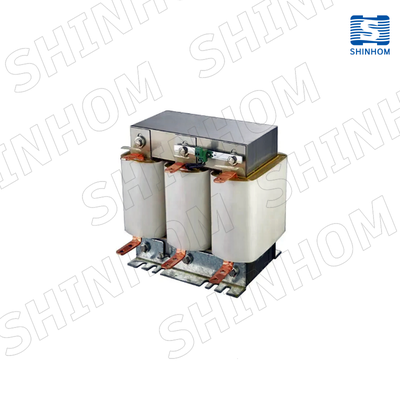
An AC reactor is mainly used for current limiting, harmonic suppression, transient voltage reduction and waveform improvement. A transformer is primarily used for voltage transformation and, depending on its design, electrical isolation. For high-frequency power conversion applications, SHINHOM also provides High Frequency Transformers.
For VFD and inverter systems where the main requirement is to control current, reduce harmonics or protect the motor and drive system, an AC line reactor or AC output reactor is typically the appropriate magnetic component.
Key Features of SHINHOM AC Reactors
Low DC Resistance
- The foil winding structure helps achieve low DC resistance, reducing winding loss and supporting efficient operation.
Strong Short-Time Overload Capability
- The reactor is designed with low magnetic flux density, good linearity and strong overload capability for demanding operating conditions.
Strong Short-Circuit Resistance
- The winding structure provides strong resistance to short-circuit forces and electromagnetic stress.
F-Class Insulation
- F-class composite insulation materials provide reliable electrical performance under demanding working conditions.
Low Noise with VPI Process
- The vacuum pressure impregnation process improves winding stability and contributes to low operating noise.
Low Core Loss and Low Temperature Rise
- Grain-oriented cold-rolled silicon steel sheets are used for low core loss, high efficiency and reduced temperature rise.
Flexible Magnetic Material Selection
Depending on application frequency and electrical requirements, different magnetic materials can be selected, including:
Grain-oriented silicon steel
- Ferrite
- Amorphous core
- Other application-specific magnetic materials
Technical Specifications
The following values are based on SHINHOM standard selection tables. Final specifications depend on system voltage, rated current, required inductance, voltage drop, installation space and application conditions.
| Parameter | Standard Specification |
|---|---|
| System Voltage | 380V / 690V standard options |
| Rated Current | 5A–1250A, depending on model |
| Insulation Class | Class F |
| Input Reactor Voltage Drop | 2% / 4% for 380V; 2% for 690V |
| Output Reactor Voltage Drop | 1% / 2% for 380V; 1% for 690V |
| Inductance | Model-dependent; standard selection tables available |
| Winding Material | Copper / Aluminum |
| Core Material | Silicon Steel / Ferrite / Amorphous Core |
| Winding Structure | Foil Winding |
| Insulation Process | VPI |
| Protection | IP00 standard configuration |
| Application | VFD, Inverter, Motor Drive, Power Conversion |
Standard Selection Range
| Reactor Type | Voltage | Voltage Drop | Rated Current | Inductance Range |
| Input AC Reactor | 380V | 2% | 5–1250A | 2.8–0.011 mH |
| Input AC Reactor | 380V | 4% | 15–1200A | 1.7–0.021 mH |
| Output AC Reactor | 380V | 1% | 5–1200A | 1.4–0.0058 mH |
| Output AC Reactor | 380V | 2% | 15–1200A | 0.85–0.01 mH |
| Input AC Reactor | 690V | 2% | 15–1200A | 1.7–0.021 mH |
| Output AC Reactor | 690V | 1% | 15–1200A | 0.85–0.01 mH |
For complete model numbers, dimensions, weights, winding materials and mounting dimensions, please refer to the AC Reactor Selection Table or contact SHINHOM for the complete specification.

VFD Input Reactor Applications
An AC input reactor can be selected when the inverter input side requires current limiting and harmonic suppression.
Typical functions include:
- Inrush current reduction
- Peak current reduction
- Input waveform improvement
- Grid harmonic suppression
- Transient overvoltage protection
- Power quality improvement
SHINHOM's selection data includes 2% and 4% voltage-drop options for 380V input reactors, allowing the reactor to be selected according to the required filtering effect and system conditions.
VFD Output Reactor Applications
An AC output reactor can be selected according to motor cable length, dv/dt requirement, motor overvoltage and harmonic conditions.
The application data in SHINHOM's reactor design documentation includes:
| Application Condition | Reference Requirement |
| Motor cable length | ≤100 m |
| Motor cable length | ≤200 m |
| Motor cable length | ≤300 m |
| Motor cable length | ≤400 m |
| Long motor cable | 300–2000 m |
| Long motor cable | 600–2000 m |
| dv/dt | <500 V/μs |
| dv/dt | <800 V/μs |
| Motor overvoltage | ≤120% |
| Output voltage THD | <5% |
The actual reactor configuration should be selected according to inverter output characteristics, motor parameters, cable length and required protection level.
AC Reactor Selection Guide
When selecting an AC reactor for a VFD or inverter system, the following parameters should be confirmed:
1. System Voltage
- Confirm the inverter or motor drive voltage, such as 380V or 690V.
2. Rated Current
- Select the reactor according to the continuous operating current of the inverter or motor.
3. Input or Output Position
Input AC Reactor:
- Used on the inverter input side for current limiting, transient protection and grid harmonic suppression.
Output AC Reactor:
- Used on the inverter output side for waveform smoothing, dv/dt reduction and motor protection.
4. Voltage Drop
- The required voltage drop affects reactor inductance and filtering performance. SHINHOM standard tables provide different voltage-drop options for input and output applications.
5. Inductance
- The required inductance should be selected according to inverter characteristics, motor requirements, switching conditions and the desired filtering effect. For inverter systems requiring isolated gate-drive control, SHINHOM also provides IGBT Drive Transformers.
6. Motor Cable Length
- For output applications, motor cable length is an important factor. Longer cables may require additional control of dv/dt, common-mode voltage, leakage current and motor overvoltage.
7. Installation Space
- Dimensions, mounting holes, terminals and weight should be confirmed before final selection.
Custom AC Reactor Manufacturing
SHINHOM provides customized AC reactor solutions for different inverter, VFD and motor drive systems.
Customization can include:
- Rated voltage
- Rated current
- Inductance
- Voltage drop
- Core material
- Copper or aluminum winding
- Insulation class
- Product dimensions
- Mounting dimensions
- Terminal configuration
- Electrical and mechanical requirements
Whether you need a custom AC reactor for an inverter, a high-current AC line reactor, a VFD input reactor, or a VFD output reactor, SHINHOM can develop the reactor according to your system requirements.
Please provide your system voltage, rated current, required inductance or voltage-drop percentage, motor power, motor cable length and installation dimensions when requesting a quotation.
Quality & Compliance
SHINHOM supports industrial customers with established quality and compliance capabilities, including:


Why Choose SHINHOM AC Reactors?
- Standard 380V and 690V reactor solutions
- Rated current options from 5A to 1250A depending on model
- 1%, 2% and 4% voltage-drop options
- Foil winding structure
- Class F insulation
- VPI process
- Low DC resistance
- Low core loss
- Low temperature rise
- Strong short-time overload capability
- Copper and aluminum winding options
- Multiple magnetic material options
- Custom electrical and mechanical specifications
- OEM and application-specific reactor solutions
FAQ
What is an AC reactor?
- An AC reactor is an inductive magnetic component used to limit current, suppress harmonics, reduce transient voltage and improve waveform quality in AC power and inverter systems.
What is an AC line reactor used for?
- An AC line reactor is installed on the input side of a VFD or inverter to reduce inrush current, suppress grid harmonics and improve input power quality.
What is the difference between an input AC reactor and an output AC reactor?
- An input AC reactor is used for input current control and harmonic suppression, while an output AC reactor is used to smooth the inverter output waveform and reduce dv/dt, motor noise and motor stress.
Can an AC reactor be used for a VFD?
- Yes. AC reactors for VFD systems can be installed on either the input or output side, depending on whether the application requires input power quality improvement or motor protection.
What AC reactor voltage and current ratings are available?
- SHINHOM standard AC reactor solutions include 380V and 690V systems, with rated current options from 5A to 1250A, depending on the reactor type and specification.
Can SHINHOM customize an AC reactor?
- Yes. SHINHOM provides custom AC reactors with customized voltage, rated current, inductance, voltage drop, dimensions and other electrical or mechanical specifications.
Request a Custom AC Reactor Quote
Need an AC line reactor for VFD, input AC reactor, output AC reactor, or custom AC reactor for an inverter?
Send us your requirements, including:
System Voltage + Rated Current + Inductance/Voltage Drop + Motor Power + Cable Length + Installation Dimensions
SHINHOM will recommend a suitable AC reactor specification and provide a quotation based on your application.
☎️Request a Custom AC Reactor Quote →
Hot Tags: ac reactors, China ac reactors manufacturers, suppliers, factory, Transformer, Ferrite Core Transformer for Smps, POE Transformer, PCB Mount Current Transformer, DC Reactor for Solar Inverters, Split Core Current Transformer