




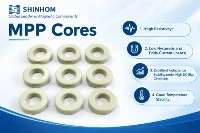
Ferrite magnetic rings mainly include nickel-zinc ferrite magnetic rings and manganese-zinc ferrite magnetic rings, and these two types of magnetic rings have strict distinctions in terms of using different frequencies. Nickel-zinc ferrite magnetic rings are suitable for suppressing electromagnetic interference in high-frequency bands; while manganese-zinc ferrite magnetic rings are suitable for suppressing electromagnetic interference in low-frequency bands.

The higher the permeability of the ferrite, the greater the impedance at low frequencies and the smaller the impedance at high frequencies. Different processes can be selected to manufacture magnetic rings according to different requirements. Magnetic rings have different impedance characteristics at different frequencies, generally with very small impedance at low frequencies, and the impedance exhibited by the magnetic ring increases sharply as the signal frequency increases.
Functions of Magnetic Rings:
Function 1: For ferrites used to suppress electromagnetic interference, the most important performance parameters are permeability μ and saturated magnetic flux density Bs. Its equivalent circuit is a series connection of an inductor and a resistor, and the values of both components are proportional to the length of the bead. When a wire passes through this ferrite core, the inductive impedance formed increases as the frequency increases. High-frequency current dissipates in the form of heat within it.
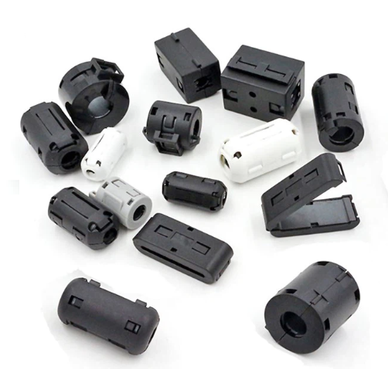
Function 2: In the low-frequency range, impedance is composed of inductive reactance. At low frequencies, R is very small, and the magnetic permeability of the magnetic core is high, resulting in a large inductance value, where L plays a major role. Electromagnetic interference is reflected and suppressed, and the loss of the magnetic core is small at this time. The entire device is a low-loss, high-Q inductive component. In the high-frequency range, impedance is composed of resistive components. As the frequency increases, the magnetic permeability of the magnetic core decreases, leading to a decrease in inductance and inductive reactance components. At this time, the loss of the magnetic core increases, and the resistive component increases, resulting in an increase in total impedance. When high-frequency signals pass through the ferrite, electromagnetic interference is absorbed and dissipated in the form of thermal energy.
Function 3: Magnetic rings absorb high-frequency components, also known as absorption filters. Ordinary filters are composed of lossless reactance components, also called reflection filters. When the reflection filter does not match the impedance of the signal source, a portion of the energy will be reflected back to the signal source, resulting in an increase in interference levels. To address this drawback, ferrite beads can be used on the incoming line of the filter to utilize their eddy current losses for high-frequency signals, converting high-frequency components into heat losses.