




Full-color monolithic micro-LED displays, leveraging advanced pixel architectures that combine red, green, and blue (RGB) sub-pixels through vertical stacking and selective material etching-regrowth techniques, are redefining the boundaries of high-resolution visual solutions. This innovation, which integrates heterogeneous semiconductor materials on a single substrate, eliminates traditional color-conversion inefficiencies and enables ultra-compact, high-brightness displays for applications ranging from augmented reality (AR) to ultra-high-definition televisions.
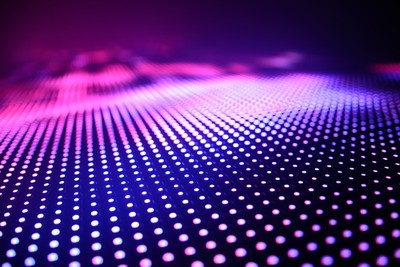
Revolutionizing Pixel Architecture
The core breakthrough lies in monolithic integration, where RGB sub-pixels are vertically aligned rather than laterally spaced. By employing dielectric sidewalls to isolate sub-pixels and utilizing nitride-based materials for blue/green emissions alongside non-nitride compounds for red, engineers achieve wavelength-specific efficiency without cross-talk. This approach resolves longstanding challenges in color uniformity and intensity balancing, critical for applications demanding precise color reproduction.
Selective area epitaxy and atomic-level etching enable the sequential growth of distinct material layers on a single wafer. For instance, red sub-pixels-traditionally hindered by low quantum efficiency in nitride-based systems-are now fabricated using alternative semiconductor alloys, grown atop blue/green layers with minimal lattice mismatch. This heterogeneous integration not only enhances luminous efficacy but also simplifies manufacturing by reducing post-processing steps.
Manufacturing Advancements
The transition to monolithic designs addresses key scalability barriers in micro-LED production. Traditional methods requiring mass transfer of individual RGB chips are replaced by wafer-level processes, where sub-pixel arrays are patterned and etched in situ. Innovations in nanoimprint lithography and plasma-enhanced atomic layer deposition (PEALD) ensure sub-micron precision during material regrowth, critical for achieving pixel densities exceeding 10,000 pixels per inch (PPI).
Thermal management, a persistent hurdle in stacked designs, is mitigated through embedded heat-dissipation channels and thermally conductive interlayer dielectrics. These refinements prevent efficiency droop at high current densities, ensuring stable performance in compact form factors like smart glasses.
Applications Across Industries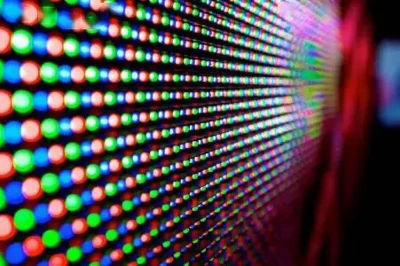
In AR/VR, monolithic micro-LEDs unlock unprecedented near-eye display quality. Their ultra-thin profile (<0.5 mm) and microsecond response times eliminate motion blur, while peak brightness exceeding 150,000 nits ensures readability in sunlight8. Early adopters in wearable tech are leveraging these traits to develop glasses-style devices capable of overlaying vivid, high-contrast digital content onto real-world environments.
The automotive sector is exploring heads-up displays (HUDs) with full-color micro-LED projections directly embedded into windshields. Unlike conventional LCD-based systems, these panels offer wider color gamuts and superior durability under extreme temperatures.
Consumer electronics stand to benefit from seamless scalability. A single manufacturing flow can yield displays spanning smartwatch-sized panels to wall-sized video walls, all maintaining consistent color accuracy and pixel density.
Challenges and Future Trajectories
Despite progress, achieving cost-effective mass production remains complex. The multi-step epitaxial regrowth process demands ultra-high-vacuum environments and defect-free substrate preparation, elevating initial capital expenditure46. Researchers are exploring hybrid bonding techniques and AI-driven defect detection to improve yields.
Another focus is enhancing red sub-pixel efficiency. While non-nitride materials address wavelength limitations, their longevity under continuous operation lags behind blue/green counterparts. Solutions involving quantum dot-photoresist hybrids and plasmonic nanostructures show promise in closing this gap.
Looking ahead, the integration of monolithic micro-LEDs with CMOS backplanes is anticipated to enable active-matrix addressing at micrometer scales. Coupled with emerging metasurface optics, this could catalyze foldable displays and holographic interfaces-ushering in an era where screens dissolve into the fabric of everyday objects.